Accredited STE Trainer & Managing Director, AusSTE
If your documentation isn’t readable, it isn’t usable. Simplified Technical English (STE) is more than a writing style—it’s a globally recognized standard that eliminates ambiguity, accelerates translation, and improves understanding across teams.
In our latest S1000D Smart Session, Contiem welcomed Dave Newdick, an ASD-accredited STE trainer with over 28 years of experience. A veteran of the Royal Australian Air Force, Dave spent 22 years working across logistics, weapons systems, and technical publications. Since then, he’s led content initiatives in mining, IT, and energy—always with the same mission: make technical communication clear, consistent, and accessible.
Dave’s session cut through the noise and showed how pairing STE + S1000D helps teams move faster, stay compliant, and scale content operations globally—with less risk and lower cost.
Want to watch the full session?
Register here to watch a full replay of the Simplified Technical English in S1000D webinar session.
Today’s documentation isn’t just for native speakers or single-site teams. It needs to work across borders, languages, and literacy levels—especially in defense, aerospace, and other high-consequence environments. Traditional writing styles—loaded with jargon, passive voice, and inconsistent terminology—create risk, slow delivery, and inflate costs.
Simplified Technical English (STE) solves this by enforcing controlled language, consistent structure, and global readability.
With STE, your team can:
STE isn’t optional when clarity matters. It’s how you reduce risk—and deliver documentation that works, everywhere.
While plain English promotes clear writing, it lacks enforcement. STE takes it further with a controlled vocabulary,
precise grammar rules, and industry-driven updates (Issue 9 released in 2024).
| Plain Language | Simplified Technical English |
|---|---|
| General principles | Strict rules and approved word list |
| Business-specific | Industry-standard, globally adopted |
| Optional structure | Structured approach improves reuse |
| Subjective style | Objective, measurable clarity |
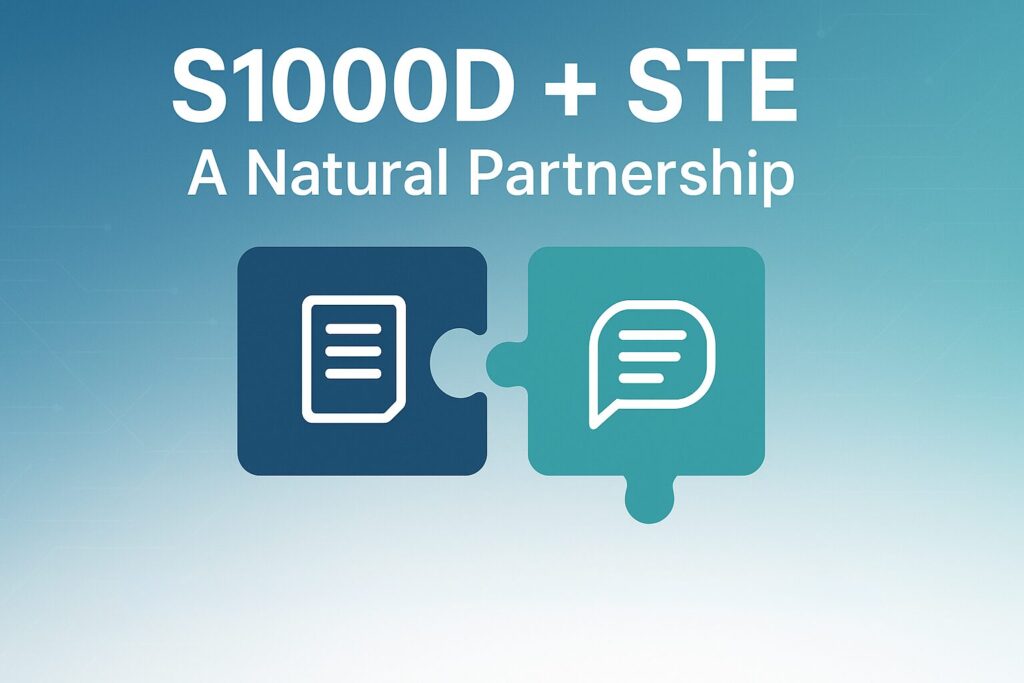
If you’re already working with S1000D—or planning to—STE is likely already part of your roadmap. The specification recommends the ASD-STE100 vocabulary and writing rules for all English-language content.
Key alignment points:
In countries like Australia, STE is no longer optional—it’s a mandated part of defense documentation projects.
…then it’s time to explore STE training and integration.
STE is not about “dumbing down” your content. It’s about writing clear, technical English that works globally. For teams operating in complex environments, the combination of S1000D + STE is a best practice for authoring, compliance, translation, and end-user comprehension.
Ready to build smarter, safer documentation? Let’s talk about how to align your team, tools, and templates with STE and S1000D.