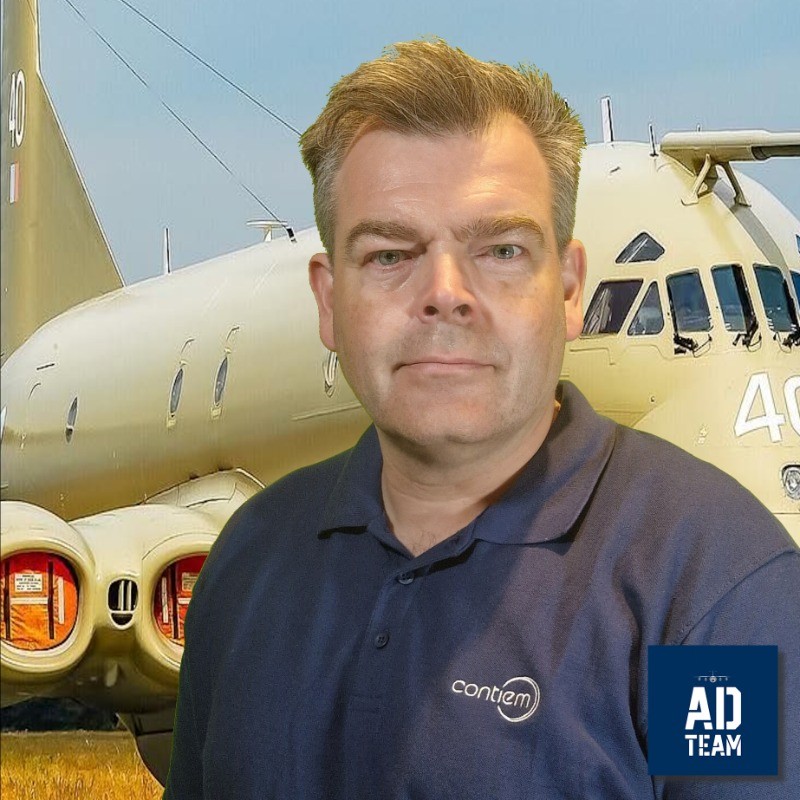
Customer Success Manager, Contiem Aerospace & Defence Team
Contiem’s own Steve Cripps recently provided a practical overview for organizations considering adoption of the S1000D specification. With 25 years of S1000D experience, Steve brings deep technical knowledge and real-world insight from his 20-year career in the Royal Air Force, where he flew Nimrods and managed Aircrew Publications.
A long-time contributor to S1000D working groups, he is passionate about making technical publications tools more user-friendly and training everyone—from authors to executives—on doing S1000D the right way. Rather than a deep technical dive, Steve’s session focused on implementation advice, common challenges, and the business case for adopting a structured content approach using S1000D.
If you’re evaluating S1000D, this session offered a clear roadmap for how to start smart, avoid common pitfalls, and unlock the long-term benefits of modular, standardsbased documentation.
Want to watch the full session? Register here to watch a full replay of the Getting Started with S1000D webinar session.
Many organizations are turning to S1000D as a strategic solution to meet evolving business needs. Whether entering new markets (such as the rapidly expanding Indian defense sector), managing decades of legacy documentation, fulfilling contract requirements, reducing documentation sprawl, or scaling delivery across multiple customers and configurations, S1000D offers a structured approach to overcome these challenges.
Before implementing S1000D, teams relied on multiple desktop publishing tools, each with its own learning curve and limitations. This fragmented approach made content difficult to maintain and often led to duplication across documents. As a result, organizations faced:
With S1000D, organizations benefit from a more efficient and structured content development process:
While based on XML, the power of S1000D lies in its three core pillars:
Common misconceptions include:
| Misconception | Reality |
|---|---|
| “S1000D is one software tool” | It’s a specification; implementation requires a toolset, usually including a CSDB, authoring tool and output engine. |
| “Plug-and-play setup” | Needs to be tailored to your project. A poor start leads to future headaches. |
| “Using XML means compliance” | Compliance requires process, governance, and audit trails—not just file format. |
| “Only for military” | Used across civil aviation, shipping, rail, energy, and satellite industries. |
One of the biggest fears for newcomers is the complexity of the specification. Contiem demystified the process, breaking it down into actionable steps and highlighting common pitfalls to avoid.
Feeling overwhelmed? That’s precisely why we created the S1000D Launchpad. This intensive, three-day workshop is designed to take you from uncertainty to an actionable starting point. We work with your team to define your project, structure your data, establish your business rules, and build a concrete implementation plan. This process often lays the groundwork for configuring notusCSDB or integrating tools like Eclipse to accelerate time to value.
Ready to stop managing documentation chaos and start building a strategic content ecosystem? From Launchpad workshops to scalable platforms like notusCSDB and Eclipse, our team can help you get started the right way.